
Developing competences and talent in the school subject

In the middle of 2023, the second phase of the big nationwide educational project “Leistung macht Schule” (LemaS; ‘talent development in schools’) started, whose program is the transfer of the knowledge and the experiences with talent development gained in the first phase (2018-2023) into more than 1.000 schools. In the first phase, the project led by almost 25 researchers worked in two main areas: In school development the focus was on a schools’ self-concept and a school program for talent development; in lesson development the focus was on pedagogical concepts and methods for identifying and promoting talents in the respective school subject, i.e. the English language classroom in the English project.
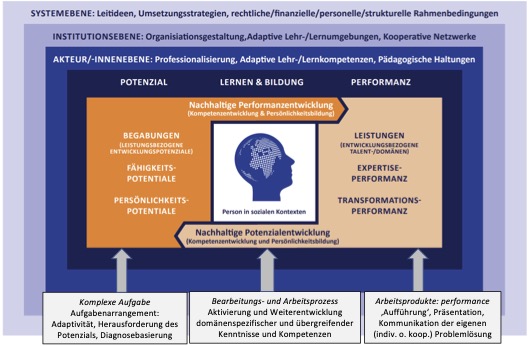
Competence development in the model of talent development
In Teaching English as a Foreign Language, cooperation with 18 teacher teams across Germany has proven that complex tasks are indeed very well suited to identify and develop talents in the daily work in the classroom.
- Complex tasks work with a holistic, personality-oriented concept of competence that corresponds to that of the learner and their ability to contribute effectively in social contexts, as shown in the integrated model of talent development.
- Complex tasks challenge individual cognitive dispositions, potentials, abilities, interests and attitudes (to the left in the model) and develop them further in the process of working on the task (upper arrow in the middle of the model).
- Complex tasks have a differentiating effect in the learning group and in the work on the common subject, because each individual student approaches the task process and task solution in their own way and can bring their own strengths and talents to bear, so that in the overall view of the learning group a whole range of different types of performance and capability is revealed (‘performance’, to the right in the model).
- The target task and the task product are also of enormous importance in that they lend visibility to the performance of each individual learner (performance, on the right), both for the learner him/herself and for the teacher.

Talent development in the subject as a task-based learning spiral
The development of competences in the classroom develops the various talents further in a spiral-like process and raises them to a higher level so that subsequent competence tasks address a further developed, higher form of talent (see spiral model) and can be further developed from there. Competence development and talent development are thus understood as a closely intertwined and continuous process of building up competences and talents on previous stages of development.

The development and promotion of competencies in the subject (the TEFL classroom) not only enables giftedness, abilities and skils to be diagnosed and evaluated. Through the development of competencies in the classroom, talents are also further developed and raised to a higher level in a spiral process. This way, subsequent competence-oriented tasks lead to a higher form of aptitude and are, in turn, further developed from there since each upward movement of the spiral is followed by subsequent spiral sections at a higher level.
The spiral structure of the model expresses the fact that
- talents require long-term stimulation, support, encouragement and continuous development;
- complex tasks are aimed at evoking performance, which then forms the basis for further tasks and learning processes as performance potential;
- competence development in the classroom is the basis for developing talents further. Talent development and competence development must therefore always be considered together, as described in the talent development model.
The potential-oriented classroom
The findings from the TEFL project of the first LemaS phase suggest that it is particularly motivating and performance-enhancing when achievements can be presented to others and thus appreciated in their diversity. On the one hand, the young people can recognize the underlying potential themselves; on the other hand, however, everyone will experience the processing, acquisition and communication of domain-specific topics and content as valuable. In other words, TEFL lessons always make the strengths and performance potential of young people visible in the development of their foreign language discourse competence; this way, the TEFL classroom is potential-oriented and appreciative and not deficit-oriented.