
Cultures in the language classroom

The cultural developments of the recent past and the present, which are indicated by keywords such as globalization, migration and digitization, are characterized by an enormous dynamic and bring with them impactful social and cultural transformations. These are accompanied by numerous developments and innovations in cultural studies and cultural theory which cultural education in the language classroom must take on board.
The pluralization of approaches to and types of cultural learning
This volume presents the most important new approaches to teaching culture in a detailed and comprehensible way and shows that cultural education in the language classroom must open up, pluralize and become more methodologically precise. In particular, it must open up to a wide range of types of cultural learning and thus create a learning space that reaches beyond the so-called intercultural approach and offers, e.g., global, historical or space-oriented learning.
The cultural semiotics approach
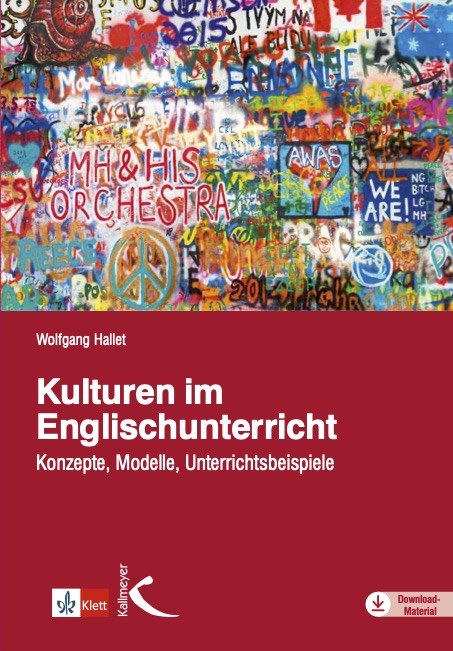
This basic work focuses on the theoretical foundations of cultural education and cultural models. The volume is essentially based on cultural semiotic approaches (Bakhtin, Geertz, Posner), expanding these to include the digital dimension and multimodality, as, in addition to linguistic-discursive ones, many other forms of expression, especially visual ones, have a culturally constitutive effect. The semiotic approach is particularly suited for the language classroom because the vast majority of aspects of other cultures can be viewed, understood and accessed in the language classroom via textual, i.e. sign-based, artifacts.
Modelling culture for the classroom
The long series of educational approaches to culture is explored in detail in chapter 3, also in a historical sense, including more recent cosmopolitan approaches and different varieties of cultural learning right up to the present day. Chapter 4 can therefore be regarded as one of the core sections of the volume, as it explores various dimensions of cultural learning by also presenting previously overlooked forms, such as cultural imagination or the performativity of all cultural action. However, the focus is on learners as cultural agents and their ability to participate in culture through the development of their discourse competence.
Principles and methods of cultural education
Part II of this book on cultural education opens a largely new chapter, that of the methods and principles of cultural teaching and learning. These include, for example, principles of determining content, creating materials, developing tasks or initiating ethnographic research by learners as an important method of teaching culture. Methods also include learning with and the understanding of photos as well as the cultural or historical contextualization of literary texts.
Types of cultural learning
Part III presents examples of important types of cultural learning, not least to demonstrate how the monolithic reduction of cultural education to intercultural learning can be overcome. Global education, historical learning and spatial learning are presented paradigmatically, each in individual chapters (11,12 and 13).
This basic work is aimed at student teachers, trainee teachers, in-service language teachers and all those involved in their training and further education at university, in teacher training colleges and in schools.
Wolfgang Hallet (2024). Kulturen im Englischunterricht. Konzepte, Modelle, Unterrichtsbeispiele. Hannover: Klett Kallmeyer